
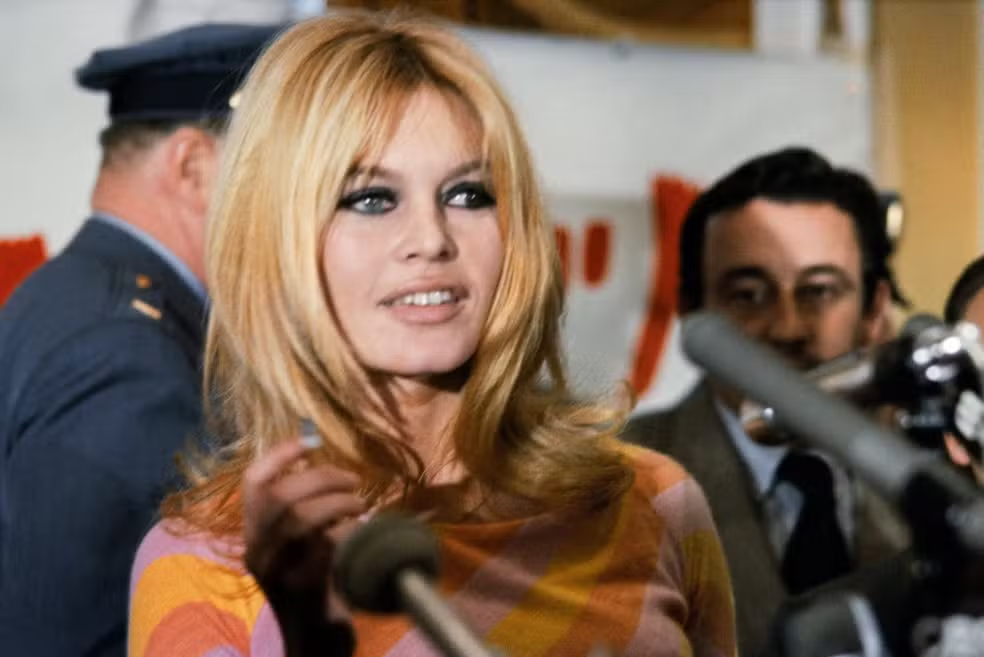

France woke up to a moment of collective reflection on Sunday after news broke that Brigitte Bardot, one of the most influential figures in the history of European cinema, had died at the age of 91. Almost immediately, tributes began to flow from political leaders, cultural institutions, artists and animal welfare organizations, underscoring the singular place Bardot occupied not only in French film, but also in public life.
For many, Bardot was far more than a movie star. She emerged in the 1950s as a global symbol of beauty and independence, reshaping how femininity and freedom were portrayed on screen. Yet her later decision to step away from acting and devote her life to animal rights ultimately defined the second half of her public identity.
French President Emmanuel Macron captured that dual legacy in a message that quickly circulated across French media. He described Bardot as a woman whose films, voice and fame shaped an era, while also highlighting her lifelong dedication to defending animals. Macron recalled how her face once served as a model for Marianne, the emblem of the French Republic, calling Bardot a symbol of freedom whose influence extended well beyond national borders.
In Italy, Deputy Prime Minister Matteo Salvini praised Bardot as a “timeless star” and emphasized her refusal to conform, describing her as a woman who fought for her convictions with courage. Italy’s culture minister, Alessandro Giuli, echoed that sentiment, noting that Bardot was not only a central figure in world cinema but also a powerful interpreter of Western freedoms. He stressed that her beauty, while undeniable, was inseparable from her fierce defense of cultural and social values.
Animal welfare organizations responded with particular emotion, reflecting Bardot’s decades-long activism after she left the film industry at the height of her fame. The Brigitte Bardot Foundation said she chose to abandon a prestigious acting career in order to dedicate her life and energy to protecting animals, a decision that reshaped her public image and inspired generations of activists.
People for the Ethical Treatment of Animals founder Ingrid Newkirk remembered Bardot as “an angel for animals,” recalling her tireless efforts, from rescuing pigeons in Saint-Tropez to taking legal action in defense of abused animals.
In France, the SPA France paid tribute to what it called her unwavering commitment to giving a voice to the voiceless. The organization credited Bardot’s advocacy, particularly from the 1970s onward, with helping change public attitudes and advance animal protection laws.
Political reactions also reflected the complexity of Bardot’s public persona. Jordan Bardella described her as a deeply loved Marianne figure whose beauty and convictions marked an entire era of French history, portraying her as a passionate patriot and defender of animals who embodied courage and freedom.
Saint-Tropez, the Mediterranean town that became inseparable from Bardot’s image, issued a statement emphasizing her role as its most famous ambassador. The city said her presence helped project Saint-Tropez onto the global stage and insisted that her memory would remain part of the town’s collective identity.
Artists who knew Bardot personally offered more intimate reflections. French actor Pierre Arditi called her the most beautiful woman in the world, but also spoke of her moral courage, suggesting her devotion to animals was rooted in a deep disillusionment with human behavior. Musician Chico Bouchikhi, a co-founder of the Gipsy Kings, recalled decades of friendship and credited Bardot with believing in the band before anyone else. He described moments in Saint-Tropez when Bardot joined them informally, dancing and laughing among friends, long before their international success.
As tributes continue to emerge, a consistent theme runs through them all. Brigitte Bardot is remembered not only as a cinematic legend who transformed French film, but also as a figure who chose conviction over comfort, controversy over silence, and activism over applause. Her death marks the end of an era, yet her influence, on screen and beyond it, remains deeply embedded in cultural memory.
