
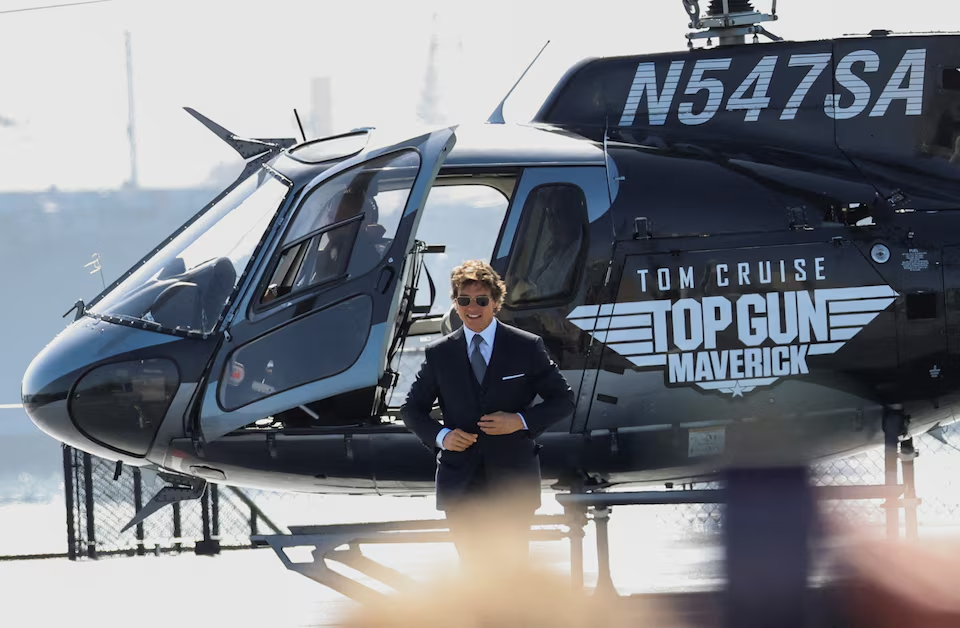

A US federal appeals court has ruled that the blockbuster film “Top Gun: Maverick” did not violate copyright law, rejecting claims that the movie unlawfully copied elements from a magazine article that inspired the original 1986 “Top Gun.” The decision represents a legal victory for Paramount Pictures and reinforces long-standing judicial standards on what constitutes protected creative expression.
In a ruling issued on Friday, the 9th US Circuit Court of Appeals in Pasadena, California, found that the 2022 sequel starring Tom Cruise was not substantially similar to “Top Guns,” a 1983 article by journalist Ehud Yonay. The article, published decades earlier, described the US Navy’s elite Top Gun fighter pilot training program in San Diego and served as the foundation for the first film.
The case was brought by Yonay’s widow, Shosh Yonay, and his son, Yuval Yonay, who inherited the copyright to the article. They argued that after terminating Paramount’s license to use the work in 2020, they were entitled to a share of the profits from “Top Gun: Maverick,” which generated approximately $1.5 billion in global box office revenue, making it one of the highest-grossing films of all time.
However, the appeals court concluded that the sequel contained multiple key elements not found in Yonay’s article. These included a prominent romantic subplot and the narrative arc of Cruise’s character, Navy Captain Pete “Maverick” Mitchell, returning as a veteran pilot to train a younger group of aviators. The judges said these differences were significant enough to defeat the claim of substantial similarity.
The panel also addressed the plaintiffs’ argument that both works explored similar themes, such as excellence in military aviation. According to the court, those similarities were framed at a broad and abstract level that is not protected under US copyright law. In its written opinion, the court stated that while general ideas and themes may overlap, copyright protection applies only to specific expressions of those ideas.
The judges further ruled that Paramount Pictures was not required to credit Ehud Yonay in “Top Gun: Maverick,” noting that the original 1983 licensing agreement did not extend to the sequel. As a result, the court upheld an earlier decision by US District Judge Percy Anderson, who dismissed the case in April 2024.
Attorneys for the Yonay family did not immediately respond to requests for comment, and Paramount also declined to comment on the ruling. The decision formally closes this dispute, though the studio remains involved in other litigation related to the film.
Paramount is currently defending a separate lawsuit in New York filed by screenwriter Shaun Gray, who alleges that scenes he wrote were used in “Top Gun: Maverick” without proper credit or compensation. Jury selection in that case is scheduled to begin in March.
The appeals court ruling underscores the high bar plaintiffs must meet to prove copyright infringement in cases involving films inspired by earlier journalistic or factual works, particularly when the alleged similarities relate to general concepts rather than specific creative expression.
