
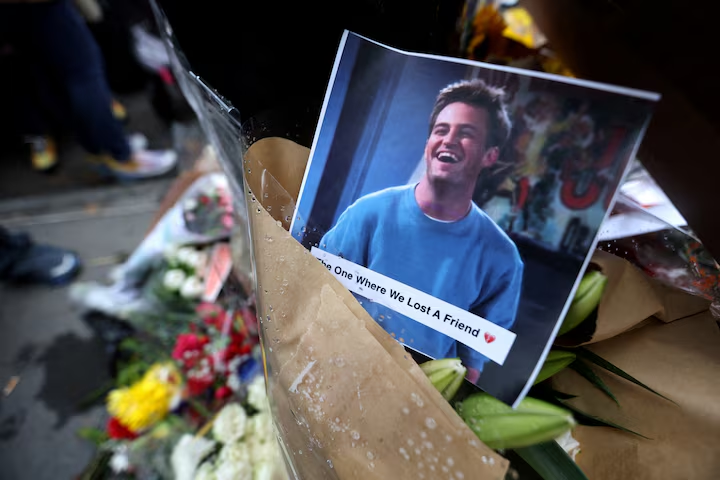

More than two years after Matthew Perry’s accidental overdose shocked Hollywood, ketamine remains at the center of a debate that blends medical promise with real-world dangers. The drug played a decisive role in the actor’s death in 2023, a case that later prompted federal charges against five people accused of supplying him with illegally obtained doses.
The incident revived questions about how ketamine works, why doctors use it, and how the same substance can shift from a controlled therapy to a life-threatening risk.
Ketamine’s long medical and recreational trail
Ketamine entered U.S. medicine in 1970, when military surgeons used it on wounded soldiers during the Vietnam War. Doctors valued how quickly it numbed pain and disconnected patients from the stress of trauma. Over the decades, the drug evolved into a tool for short procedures, pain control and, more recently, treatment of severe depression.
The renewed medical interest coincided with a surge in illicit consumption. Ketamine traveled from clinics to nightclubs as its hallucinogenic and dissociative effects became popular in rave culture. Users commonly take it as a powder or smoke it after converting it into crystalline form. Street names such as “special K,” “Kit Kat” and “Vitamin K” reflect how widely it spread beyond hospitals.
The U.S. Drug Enforcement Administration classifies the drug as Schedule III, meaning it carries a moderate to low potential for abuse but still requires strict oversight.
A growing role in mental-health care
For many patients, ketamine provides relief when conventional antidepressants fail. That view gained regulatory backing in early 2025, when U.S. authorities expanded approval for Spravato, a ketamine-derived nasal spray produced by Johnson & Johnson. The decision allowed doctors to use the medication on its own rather than pairing it with other antidepressants.
Because ketamine acts on the neurotransmitter glutamate, its effects appear far more quickly than traditional antidepressant drugs. This speed has made it appealing for patients experiencing intense depressive episodes or suicidal ideation.
Clinicians, however, warn that ketamine requires careful monitoring. High doses can trigger hallucinations, spikes in blood pressure and disorientation. For that reason, most hospitals avoid using it as a primary anesthetic except in specific emergencies such as burn care or trauma surgery. Instead, specialists tend to combine smaller doses with other anesthetics to ease pain after operations.
Some researchers see promise in other areas too. Medical studies have explored ketamine’s potential benefits for neurological conditions, including migraines, epilepsy and stroke.
The chain of events behind Perry’s overdose
Investigators said Matthew Perry received supervised ketamine infusions at a licensed clinic to help treat depression. Those sessions alone did not explain his fatal overdose. According to federal documents, the actor later obtained vials of the drug outside medical settings after seeking larger or more frequent doses than his clinic would authorize.
Authorities said he turned to a network of suppliers, including physicians who eventually pleaded guilty to federal drug charges. One of them, Dr. Salvador Plasencia, allegedly showed Perry’s assistant, Kenneth Iwamasa, how to inject the drug at home. Iwamasa admitted in court records that he administered multiple doses to the actor, including one on the day Perry died.
An autopsy revealed that Perry had ketamine concentrations comparable to levels used in general anesthesia. The report said the drug overstimulated his heart while suppressing his breathing, causing him to lose consciousness in his hot tub and drown.
Additional risk factors
Specialists warn that ketamine therapy is not suitable for everyone. Doctors advise against using it in patients with schizophrenia or bipolar disorder because the drug can intensify symptoms. Cardiologists also highlight the dangers for people with high blood pressure or underlying heart disease, since the drug can raise blood pressure and strain the cardiovascular system.
The convergence of clinical promise, recreational use and easy access outside regulated settings continues to make ketamine a complex drug for regulators and clinicians. Perry’s case underscored how quickly that balance can collapse when doses move beyond medical supervision.
