
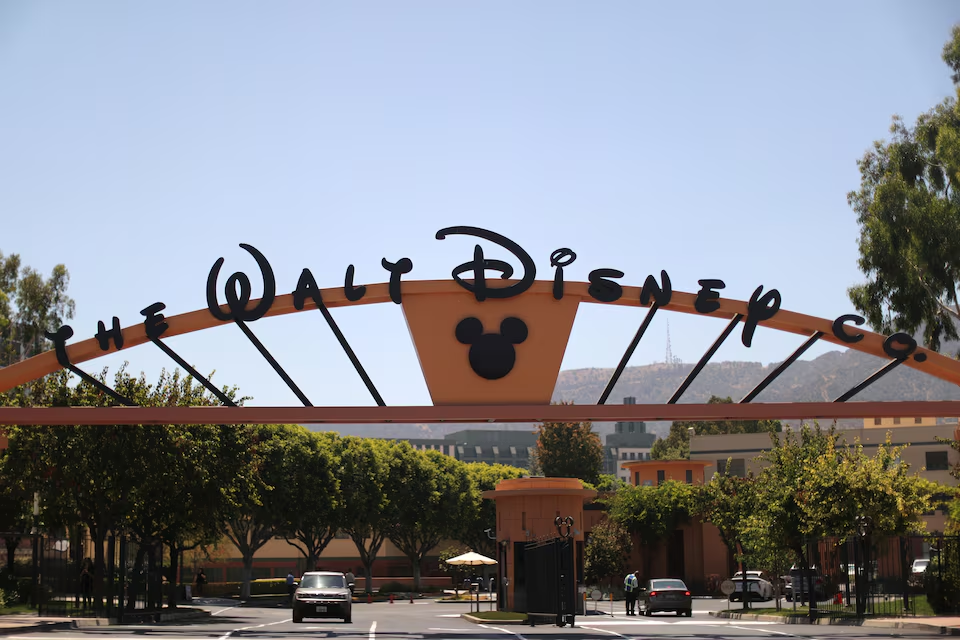

Shares of The Walt Disney Company slid nearly 5% on Monday after the company warned that a decline in international visitors to its U.S. theme parks, combined with weaker earnings in its television and film businesses, weighed on recent performance. The update came as Disney prepares for a leadership transition ahead of the departure of chief executive Bob Iger later this year.
Disney said its parks business faced “headwinds” from overseas visitors, without specifying the causes, at a time when foreign travel to the United States has softened more broadly. Chief financial officer Hugh Johnston said the company is increasing its focus on domestic consumers, noting that Disney currently has less visibility into demand from international travelers.
The experiences division, which includes theme parks, cruise lines and consumer products, remains the company’s largest profit driver. In the fiscal first quarter ended December 27, the unit generated about $10 billion in revenue and accounted for roughly 72% of Disney’s quarterly operating profit of nearly $5 billion. Despite that performance, investors reacted sharply to signs that international tourism trends could pressure the parks business going forward.
Disney’s entertainment segment, which houses its film studios, television networks and streaming platforms, reported a 35% decline in operating profit. The company attributed the drop to higher marketing costs tied to a crowded theatrical release schedule that included box office successes such as “Zootopia 2” and “Avatar: Fire and Ash.” Disney also said it would no longer disclose revenue and operating income for its traditional TV channels, with Johnston describing those metrics as less relevant as distribution shifts further toward streaming.
Market analysts pointed to the parks division as the main driver behind the share price move. Ben Barringer, head of technology research at Quilter Cheviot, said the size and importance of the parks business meant any sign of weakness there was likely to have an outsized impact on investor sentiment.
The company is also navigating uncertainty around its next chief executive. Disney is expected to name a successor to Iger early this year, with industry executives widely viewing Josh D’Amaro, chairman of the experiences division, as the leading candidate. Analysts at Bank of America said the succession question has been an overhang on the stock, adding that D’Amaro’s appointment would likely be well received given the performance of the parks-led business.
Disney’s broader financial results for the quarter were mixed. Overall revenue rose 5% to $26 billion, exceeding analysts’ expectations of $25.7 billion, while income before taxes came in at $3.7 billion, above Wall Street forecasts. Adjusted earnings per share fell 7% from a year earlier to $1.63, though that figure still beat estimates.
The company reaffirmed its full-year outlook, projecting double-digit growth in earnings per share compared with fiscal 2025. Disney also said it expects to generate $19 billion in cash from operations and remains on track to repurchase $7 billion of its own shares.
Industry data underscore the broader travel trends affecting Disney. The United States recorded a 6% decline in foreign visitors in 2025, even as global tourism spending rose, according to the World Travel & Tourism Council. Analysts have cited factors such as U.S. immigration policies and shifting traveler preferences toward destinations in Europe and Asia.
Elsewhere in the business, Disney’s sports unit reported a 23% drop in operating income after a contract dispute with YouTube TV temporarily cut access to channels including ESPN, resulting in a $110 million hit. By contrast, the company’s streaming services, including Disney+, Hulu and ESPN’s direct-to-consumer offerings, posted a 72% increase in operating income to $450 million, with revenue rising 13% to $4.4 billion.
